
ChatGPT può creare un vantaggio competitivo?
Sergii Shelpuk · Managing Partner

Negli ultimi sei mesi ChatGPT ha conquistato internet. Questo prodotto di punta di OpenAI ha superato il milione di utenti in appena cinque giorni, stabilendo un nuovo record tra i prodotti digitali. Sui social e nelle fonti più autorevoli si discute senza sosta se ChatGPT e tecnologie simili finiranno per ridefinire interi settori e trasformare il lavoro d’ufficio.
La domanda, quindi, è questa: ChatGPT può offrirvi un vero vantaggio competitivo? Oppure dovreste preoccuparvi del fatto che i vostri concorrenti possano usarlo per sottrarvi una parte del mercato? Proviamo a ragionarci in modo più rigoroso.
ChatGPT può costruire un vantaggio competitivo per la vostra azienda?
La chiave di un vantaggio sostenibile è possedere qualcosa che i concorrenti non possano copiare facilmente: asset, relazioni, reputazione, marchio o un design di business unico. Negli ultimi decenni il machine learning e l’IA hanno dimostrato di poter trasformare i dati in un vantaggio competitivo durevole. Il meccanismo funziona come un circolo virtuoso: l’IA converte i vostri dati proprietari in valore percepito per il prodotto; più il valore percepito aumenta, più utenti e interazioni generano nuovi dati proprietari, fino a creare un prodotto sempre più difficile da imitare. Il posizionamento ideale di un prodotto di IA può essere visualizzato così:
- Dovete offrire un prodotto migliore per sottrarre quota di mercato a un prodotto di IA.
- Poiché il valore nasce dai modelli di IA, vi servono modelli migliori.
- Poiché i modelli moderni vengono addestrati sui dati, vi servono più dati.
- Poiché i dati arrivano dall’uso del prodotto, vi serve un prodotto migliore.
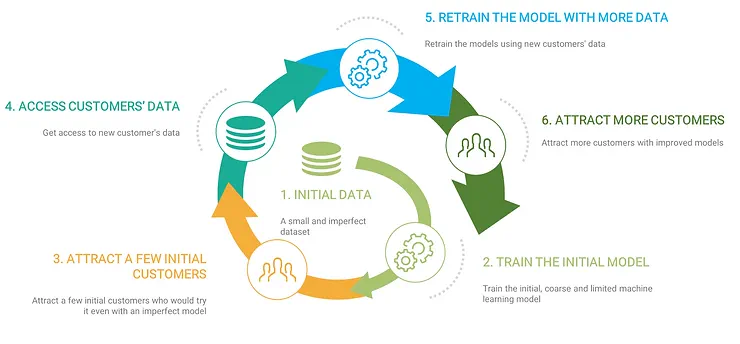
Questo tipo di architettura strategica scoraggia i concorrenti in modo molto efficace. Vale persino per prodotti come Google Search o YouTube che, se fossero davvero replicabili, potrebbero spingere qualunque azienda verso valutazioni da trilioni di dollari. Eppure la loro posizione di mercato resta solidissima: i potenziali sfidanti capiscono prima del tempo quanto sia ardua la battaglia, oppure lo imparano dopo averci provato invano.
Let us now return to ChatGPT, an OpenAI product in its current form. Where does it fit within this cycle?
An AI system should enhance its performance with more data as it undergoes further training. However, ChatGPT is an immutable product — you cannot train it using your proprietary data. Prompt engineering is akin to programming rather than machine learning training, meaning that your prompts can be equally copied by skilled engineers or even by one of your own competitors. From this perspective, you can liken ChatGPT to a sophisticated spreadsheet — it can provide value and save time, but it does not create a sustainable competitive advantage for your company.
Per costruire un vero vantaggio competitivo, il vostro sistema di IA dovrebbe essere addestrato su dati proprietari: dati che la vostra azienda possiede e che i concorrenti non possono ottenere facilmente. È questo che rende il vostro sistema diverso da quello che altri potrebbero sviluppare senza accesso a quelle informazioni.
Tutto ciò che inviate a ChatGPT confluisce nei dataset di OpenAI e contribuisce a migliorare il prodotto, a vantaggio non solo della vostra azienda ma anche di qualunque concorrente sia disposto a pagare 20 dollari al mese per usare uno strumento potenzialmente esposto ai vostri dati. L’estrazione di dati dai modelli linguistici resta un problema aperto, quindi dovreste considerare qualsiasi informazione condivisa con ChatGPT come sostanzialmente esposta al mondo esterno. Se inviate dati proprietari a ChatGPT, state facendo l’opposto di ciò che serve per creare un vantaggio competitivo: li state cedendo.
In sintesi, ChatGPT è un prodotto di IA che non potete personalizzare davvero addestrandolo sui vostri dati. Anche se OpenAI può migliorare il modello sfruttando informazioni che gli fornite, i benefici risultanti non restano esclusivi per voi: finiscono, direttamente o indirettamente, per favorire anche il resto del mercato.
Potete e dovreste usare ChatGPT per aumentare l’efficienza dove ha senso. Ma non va confuso con quelle tecnologie di IA che, se progettate bene, possono davvero rendere la vostra azienda leader di mercato. ChatGPT, da solo, non svolge quel ruolo.
Large Language Model (LLM)
È abbastanza chiaro che ChatGPT, da solo, non crea un vantaggio competitivo. Ma vale lo stesso per gli altri large language model? È possibile sviluppare un sistema simile a ChatGPT e attivare davvero un circolo virtuoso dell’IA?
Let us examine the technologies that drive opportunities for AI competitive advantages. First and foremost, we have those that enable the construction of this virtuous cycle using new types of data. The "Eureka" moment came with AlexNet at the 2012 ImageNet competition, where convolutional neural networks reached a level of sophistication that allowed them to extract value from vast datasets of real-world images — a challenge that earlier computer vision algorithms based on feature extractors struggled with. In simple words, it showed that you can build a sustainable and defensible business with a product that collects real-world photos while utilizing them to improve itself with the convolutional neural networks. Those who grasped this concept early on swiftly identified applicable niches and capitalized on them. An excellent example is Blue River Technology, which emerged soon after the breakthrough of AlexNet and applied the newly available convolutional neural networks to images of farm fields.
Torniamo ora ai large language model. Possono attivare il circolo virtuoso dell’IA per nuovi tipi di dati?
Un LLM simile a ChatGPT passa in genere attraverso tre fasi di addestramento.
Nella prima fase si costruisce un modello linguistico addestrando il Transformer a prevedere la parola successiva sulla base di una certa finestra di contesto. In questa fase il modello sa completare il testo, ma non sa ancora sostenere un dialogo o rispondere in modo utile a una richiesta.
Nella seconda fase il modello viene addestrato su un dataset domanda-risposta di alta qualità, così da imparare a rispondere alle richieste degli utenti. Il risultato è il cosiddetto modello SFT, cioè un modello sottoposto a supervised fine-tuning.
La terza fase è il Reinforcement Learning from Human Feedback, o RLHF. In pratica si raccolgono preferenze umane tra risposte alternative, così da insegnare al modello quali output siano più vicini al risultato desiderato. È questo passaggio che trasforma l’LLM nell’assistente conversazionale che oggi conosciamo.

Qualcuna di queste tecnologie apre davvero nuove nicchie, abilitando nuovi tipi di dati come aveva fatto AlexNet a suo tempo?
Training the LLM to predict the next word can be a demanding and costly endeavour. The estimated training cost for training the GPT3 model from scratch exceeds $4 million, and the training time can take up to 9 days. Very few companies can afford such expenses regularly (remember that the model needs regular retraining to capitalize on new proprietary data). Additionally, although smaller and more cost-effective LLM architectures are available, a model that predicts the next word alone is of limited use, even if trained with proprietary data. You still need to enable chat capabilities through RLHF.
Qui si apre una possibilità interessante: il training domanda-risposta e il RLHF possono davvero contribuire a costruire un vantaggio competitivo sostenibile.
Se riuscite a immaginare un prodotto che crea valore attraverso funzioni di chat o assistenza e che, allo stesso tempo, genera dati utilizzabili per il RLHF dalle interazioni degli utenti, potreste essere davanti a qualcosa di davvero rilevante.
This way, your product will improve with new "question-answer" or response quality metric data and, in turn, generate more training data as it enhances its performance.
The size of this opportunity is difficult to determine. Clearly, there are specific niches where such feedback can be obtained, primarily in the writing aid market where companies like Grammarly operate. How easily LLM technologies can disrupt this obvious market remains to be seen. However, if you wish to evaluate your own LLM-based startup idea or someone else's, consider two questions:
- How do LLM improvements bring more value to the users?
- How do users generate training data when using the product?
Se almeno una di queste due domande non ha una risposta convincente, è molto probabile che attorno a quell’idea non si possa costruire un business davvero difendibile.
La concorrenza tra LLM
Ever since the explosive debut of LLMs, prominent tech giants have entered the fray. Microsoft invested a staggering $10 billion in OpenAI and incorporated ChatGPT into its Bing search engine. Google introduced Bard, while Meta open-sourced the LLaMA large language model, among other notable developments. Many view LLMs as a potential disruptor in the online search market, an area that has long been dominated by Google Search. To better comprehend their endeavours, let's apply the logic of competitive advantage.
Feedback loop
ChatGPT exhibits remarkable proficiency in various tasks, including coding—a subject that often sparks debates about the automation of software engineering. However, these capabilities heavily rely on RLHF training data. OpenAI, for instance, employs software engineers dedicated to producing such data by solving programming challenges akin to those found on LeetCode and providing detailed explanations in human language. Additionally, the company engages a significant number of data labellers to create other forms of RLHF training data. There are rumours that Google extracts RLHF data from ChatGPT to train their own LLMs. Nevertheless, from the perspective of AI competitive advantage, these approaches have inherent flaws.
While manual data labelling can yield substantial training data, a product design that generates RLHF data directly through user interactions as part of their journey can surpass manual labelling through a stronger feedback loop.
OpenAI attempted to address this by introducing a "like/dislike" feature in ChatGPT. However, liking or disliking chat responses is not an essential aspect of the user journey — I can benefit from the product without explicitly expressing my preference.
Accesso ai dati
Moreover, a robust AI competitive advantage should be built upon proprietary data that is difficult for competitors to acquire. Google Search's dominance is largely due to leveraging our historical search queries and interactions, complemented by vast amounts of data collected through various Alphabet products. Our Gmail emails, YouTube searches, views, and interactions, browsing data from Google Chrome, and even phone usage data from Android devices all contribute to the intricate user models and embeddings that Google meticulously constructs for each individual. These personalized user models, combined with our search queries, enable Google Search to present tailored and relevant results. As search results improve, we naturally gravitate back to Google for further searches, providing the company with even more data to enrich our individual user models. The power of Alphabet's AI products stems from this exclusive dataset. Attempting to replicate Google Search is a doomed endeavour precisely due to the lack of access to this data.
Does OpenAI, Google, or any other company possess unique training data or a product design that generates it? Hardly so.
Alternative open source
Consider the thriving ecosystem of open-source LLMs and LLM chats that has flourished over the past six months. There are hundreds of open-source LLMs, many of which can be utilized commercially. These models are smaller, more cost-effective to train, and, most importantly, customizable — since the competitive advantage lies in having a unique model. Open-source pretraining and RLHF datasets are readily available, and new developments emerge on a daily basis. In this environment, neither OpenAI, Google, nor Microsoft possesses a distinctive asymmetry that would enable them to create superior LLMs while being challenging to replicate by other companies or even individual engineers.
Interestingly, even Google, a company well-versed in building AI competitive advantages, appears to acknowledge this reality. In a leaked document, Google senior software engineer Luke Sernau admits that Google lacks a competitive advantage in developing LLMs. The document notes, "The uncomfortable truth is, we aren't positioned to win this arms race, and neither is OpenAI. While we've been squabbling, a third faction has been quietly eating our lunch... I'm talking, of course, about open source." Sernau suggests that without a "secret sauce," Google's best approach is to learn from and collaborate with external efforts while prioritizing third-party integrations. Sernau said open-source engineers were doing things with $100 that "we struggle with" at $10 million, "doing so in weeks, not months."
In summary, the development of general LLMs appears to be beyond the control of any individual large company, even the largest ones. Currently, none of them seems to possess a foolproof strategy to entrench their position — this includes Google, which has successfully established itself with Search, YouTube, and numerous smaller products.
Once again, this confirms my earlier suggestion: finding a niche where LLMs can establish a sustainable competitive advantage that cannot be swiftly replicated is incredibly challenging.
Che cosa dovreste fare, quindi?
Having started my career in AI long before the current hype and even before the "AlexNet moment" of ImageNet 2012, I can confidently say that the current ChatGPT frenzy even overwhelms someone like me who is well-versed in the field. I can only imagine how it appears to those outside the industry, with this immense buzz generating anxiety and the fear of missing out among many individuals. Since the launch of ChatGPT, numerous friends and colleagues have approached me, seeking advice on whether they should be concerned about their businesses or even their careers.
Vorrei proporvi un modo più utile per ragionare sull’attuale sviluppo degli LLM.
Una buona analogia vale più di molte spiegazioni: pensate agli LLM come all’ondata dei PC IBM degli anni Ottanta e Novanta.
Personal computers gained tremendous popularity during those decades, primarily due to word processors and spreadsheet software that simplified routine tasks. By 1984, IBM's revenue from the PC market exceeded $4 billion, more than double that of Apple. A study in 1983 found that two-thirds of large customers who standardized on one computer opted for the PC, while a mere 9% chose Apple. A 1985 Fortune survey revealed that 56% of American companies with personal computers used PCs, while 16% used Apple.
However, a series of intellectual property protection mistakes made by IBM led to the emergence of the entire "IBM PC compatible" clone industry. This was devastating for IBM, but for the tech world, the IBM PC and its clones became one of the most significant events in history.
If you are a business executive contemplating the ChatGPT hype today, put yourself in the shoes of your colleagues who lived through the PC era. PCs were undoubtedly a great innovation, automating many routine tasks, simplifying accounting, and replacing typewriters. However, these machines were also affordable and readily available.
Would you expect your competitor or a young startup to oust you from the market simply by introducing PCs to their workplace? For most, the answer is: hardly. After all, you can acquire those computers for your own company whenever you see fit. While they may enhance your business, they are not a threat to your market share.
E se siete imprenditori che stanno valutando una nuova iniziativa, tenete presente un fatto importante: l’industria dei cloni IBM PC degli anni Ottanta e Novanta aveva margini estremamente bassi.
Anche se potevate assemblare e vendere computer usando componenti compatibili IBM facilmente reperibili, potevano farlo tutti gli altri. In un contesto del genere l’unico modo per competere è sul prezzo, e questo porta inevitabilmente tutti verso margini sottilissimi.
However, take inspiration from Microsoft, which developed operating systems for IBM PCs and eventually transformed Windows into one of the most successful platforms of all time. If you can create a product that every LLM user needs and build it with the concept of sustainable competitive advantage, you may find yourself with a thriving business in due course. But that is a different story altogether.
This blog is dedicated to AI competitive advantage, and we are doing our best to explain how it works and how you can build one for your product or company. You can check our other posts to get an extensive explanation of what the network effect is e how AI enables it, how to build an AI competitive advantage for your company, what culture helps you build the right AI products, what to avoid in your AI strategy and execution e altri approfondimenti.
Vi serve aiuto per costruire un vantaggio competitivo basato sull’IA?
Il nostro team di esperti di business e consulenti di tecnologia IA aiuta da anni aziende tecnologiche come la vostra a costruire vantaggi competitivi sostenibili grazie all’IA.