
Management competente: un vantaggio competitivo

Uno dei pilastri di un vantaggio competitivo durevole consiste nel trasformare un asset difficile da acquisire per i concorrenti in valore percepito per il prodotto. Questo vantaggio può nascere da molte fonti: marchi forti, brevetti, economie di scala, relazioni personali, regolamentazione o dati. Il punto centrale è sempre una feedback loop positiva: più sviluppate il vostro vantaggio competitivo, più esso diventa forte e più difficile sarà per altri copiarlo.
In questo articolo analizziamo proprio questi circoli virtuosi e il loro opposto, cioè i circoli viziosi, guardando a una fonte di vantaggio competitivo spesso sottovalutata: il management competente.
Temporaneo o duraturo?
Nel suo fondamentale articolo del 1996, "What is Strategy?", Michael E. Porter sosteneva che l’efficienza operativa non potesse essere considerata un vantaggio competitivo sostenibile, perché le pratiche manageriali, in teoria, sono relativamente facili da copiare.
Le conclusioni di Porter nascevano osservando i produttori automobilistici giapponesi degli anni Ottanta. Il movimento dell’efficacia operativa affonda le radici nei progressi compiuti dalle imprese giapponesi negli anni Settanta e Ottanta, quando riuscirono a superare molti concorrenti occidentali sia in qualità sia in costi. Pratiche oggi considerate standard, come il Total Quality Management e il Lean Manufacturing, si sono diffuse proprio in quel contesto, con Toyota come riferimento principale e con l’influenza teorica del Scientific Management di Frederick Winslow Taylor.
Tuttavia, come hanno spiegato Michael Porter, Hirotaka Takeuchi e Mikio Sakakibara nel libro del 2000 "Can Japan Compete?", molte aziende giapponesi avevano eccellenti pratiche operative ma una strategia debole o assente. Le imprese con una strategia davvero distinta, come Sony, Canon o Sega, erano l’eccezione. La maggior parte si limitava a replicare gamma prodotti, caratteristiche, servizi e pratiche dei concorrenti. Quando gli attori internazionali impararono a imitare quelle tecniche, emerse con chiarezza quanto poco restasse a difesa del loro vantaggio.
Un’azienda può superare i concorrenti solo se riesce a costruire una differenza durevole. Le migliori pratiche operative, prese da sole, erano evidentemente troppo facili da copiare.
La ricerca della Harvard Business Review
Dal 2002 la Harvard Business Review ha studiato in profondità il modo in cui le organizzazioni di 34 Paesi adottano, o trascurano, pratiche manageriali fondamentali. Basandosi su uno strumento sviluppato originariamente da John Dowdy e Stephen Dorgan in McKinsey, i ricercatori hanno valutato 18 pratiche distribuite su quattro aree: gestione operativa, monitoraggio delle performance, definizione degli obiettivi e gestione dei talenti.
Operations management
- Use of lean techniques
- Reasons for adopting lean processes
Performance monitoring
- Process documentation
- Use of key performance indicators
- KPI reviews
- Discussion of results
- Consequences for missing targets
Target setting
- Choice of targets
- Connection to strategy, the extent to which targets cascade down to individual workers
- Time horizon
- Level of challenge
- Clarity of goals and measurement
Talent management
- Talent mindset at the highest levels
- Stretch goals
- Management of low performance
- Talent development
- Employee value proposition
- Talent retention
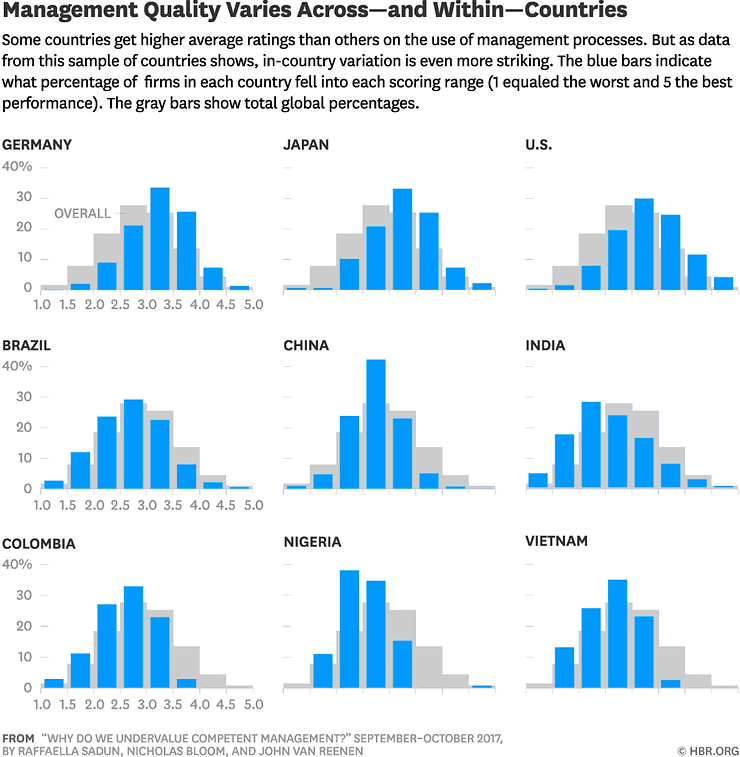
Scores ranged from low to non-existent at the lower end to highly developed at the upper end. In conjunction with the Centre for Economic Performance at the London School of Economics, the HBR team has interviewed managers from over 12,000 firms regarding their practices. Based on the collected data, they graded each organisation on each management practice, using a scale from 1 to 5, where higher scores imply broader adoption.
Two key findings stem from this research.
Firstly, attaining operational excellence remains a tremendous hurdle for many organisations. Even firms with ample information and good structure often grapple with it. This is a consistent challenge across countries and industries — even though many of the managerial processes they studied are widely recognised.
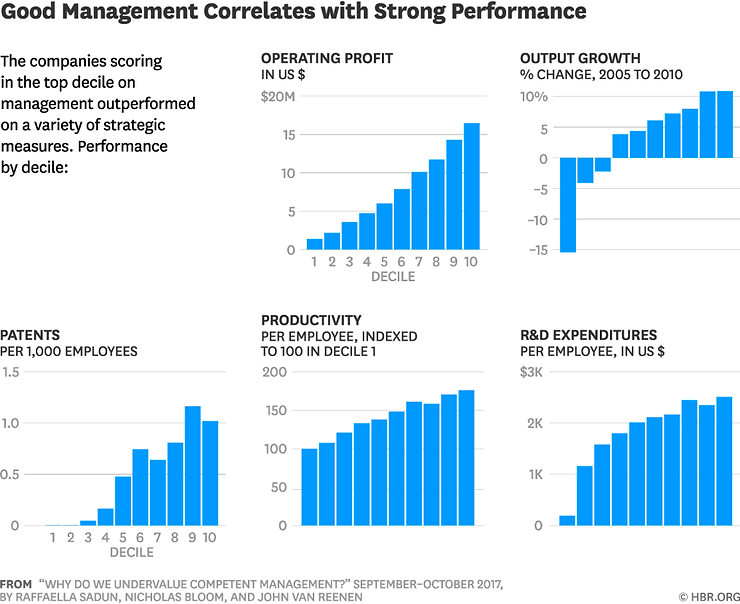
Secondly, substantial, ongoing gaps in fundamental managerial practices correlated with significant, continuous differences in the performance of companies. The data indicate that better-managed firms are more profitable, grow quicker, and are less likely to fail. Moving a firm from the worst 10% to the best 10% in management practices correlates with a $15 million increase in profits, a 25% faster annual growth, and a 75% increase in productivity.
Yet these empirical results pose a significant question: If the benefits of core managerial practices are so vast and compelling, why does every firm not concentrate on copying them?
Why the companies still do not replicate the best managerial practices?
Misguided Beliefs
HBR research shows that a shockingly large number of managers cannot objectively gauge how poorly (or well) their firms are run.
Comparable biases are observed in other contexts. For instance, 70% of students, 80% of drivers, and 90% of university teachers consider themselves 'above average.'
Reflect on the average response to the question, "On a scale from 1 to 10, how well managed is your firm?". Most managers have an overly positive view of the quality of their companies' practices. Indeed, the median response was a 7. Moreover, the research found no correlation between perceived management quality and actual quality, suggesting that self-assessments are often detached from reality.
This sizeable gap is troublesome because it implies that even managers who genuinely need to improve their practices often don't take the initiative, mistakenly believing they're doing fine.
Vicious Cycle
While HBR research attributes skill deficits as a catalyst for the current predicament, I wish to spotlight an alternative angle contributing to this perpetual downward spiral of sub-par management methods.
Imitating a management method is hardly an arduous task in and of itself, but you must choose carefully what to imitate. In this era of abundant information and global connectivity, one may be fooled into thinking that knowledge and facts are readily available 'out there', just waiting to be discovered. However, what truly lies 'out there' is often a reflection of our own confirmation bias or what others would find advantageous for us to believe. Facts are present too, but as Timothy Snyder has observed, they require labour.
This is even more true for managerial practices. The internet readily overwhelms you with articles extolling the virtues of rather esoteric management styles that someone is trying to sell you. And the business sections of bookshops are chock-full of autobiographies and testimonials penned by individuals enjoying their moment in the limelight (or their ghostwriters) for various reasons. Deciphering a potentially beneficial management practice from the sea of esoteric jargon and self-promotion requires qualification.
Now, let's consider an enterprise suffering from poor managerial methods. These methods didn't materialise from thin air; people introduced them – often the current management team or proprietors. They surely did not set out to foster poor managerial habits within their organisation, yet, here we are. A plausible explanation could be their inability to distinguish effective management from ineffective, and in their attempt to emulate successful practices, they inadvertently instilled poor management methods within their firm.
This state of affairs traps the company in a stasis. Managers lacking the necessary qualifications struggle to distinguish effective management practices from ineffective ones, thus hindering their ability to select the appropriate ones to replicate. Furthermore, they struggle to differentiate between competent managers and those lacking the necessary qualifications, thereby stymieing the evolution of the company's management culture and skillset.
The Startup Bane
Unsurprisingly, HBR research reveals that the companies with the worst management practices are founder-owned companies with founder CEOs.
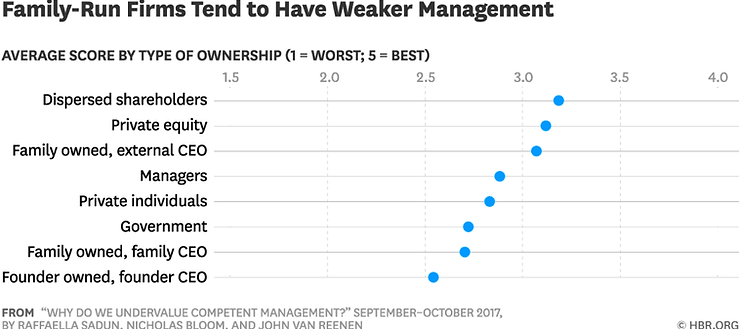
This scenario aligns with a substantial number of startups. It's all too easy to succumb to the enchanting allure of startup pop-culture, which lauds 'vision', 'motivation', 'charisma', and 'positive thinking', concepts amplified by the roar of social media. Nevertheless, such attributes are hardly substitutes for proper qualifications and competence.
And the lack of managerial ones can doom your company to failure. As one startup founder and CEO told me, 'There is no place for managers in my company, and there never will be.' It is no surprise his company struggled throughout its entire existence.
Conversely, at the other end of the spectrum, the presence of competent managers can provide a significant advantage over competitors. As Michael Porter stated, once you've identified a successful management practice, emulating it is not a challenging feat. Recruiting more qualified managers paves the way for further fortifying your company's competitive advantage.
Some years ago, I had the opportunity to work as a business analyst for SoftServe, a software development firm. During one of my projects, I applied the change management principles described by Laurie J. Mullins in his insightful book, "Management and Organisational Behaviour." This resource, once a core textbook during my days at the London School of Economics and Political Science, has since become an essential reference for me. My colleague, Andrew Kosar, instantly recognised the influence of 'Mullins', as he noted with a knowing smile.
SoftServe consistently demonstrated exceptional management culture and practices – a fact that evidently contributed to its significant growth. Over the past decade, SoftServe expanded 4x, increasing its team from 3,000 to 13,000, whilst achieving a remarkable $750M+ annual turnover, all without any external investment. The firm's internal culture facilitated the establishment of the SoftServe Data Science Group, one of the first AI service lines among European software companies, and I was privileged to become SoftServe's first Director of Data Science in 2013. Numerous SoftServe alumni have gone on to found many tech startups and service companies.
There is no shame in underdeveloped management practices for a startup company, especially at the early stages – the whole point of the emerging enterprise is to develop the value proposition and product while staying afloat among the tremendous uncertainties. However, a continuous disregard for managerial practices and culture could spell disaster for a firm, especially once competition rears its head.
In building a sustainable competitive advantage, paying attention to nurturing virtuous cycles is crucial. Yet, it is equally essential to be aware and avoid the vicious cycles that, if left unchecked, may threaten your entire business.
This blog is dedicated to AI competitive advantage. Check our other posts for extensive explanations of what the network effect is and how AI enables it, how to build an AI competitive advantage, what culture helps, and what to avoid in your AI strategy.
Strengthen Your Competitive Advantage Through Competent Management
Our team of business experts and AI technology consultants helps you build sustainable competitive advantages through technology and management.